
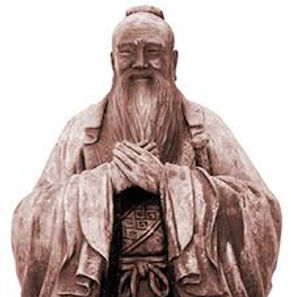
Confucianism was developed in China by Kong Qui(Master Kong) in 551-479 BC
Kong Qui

Confucianism is often characterized as a system of social and ethical philosophy rather than a religion. In fact, Confucianism built on an ancient religious foundation to establish the social values, institutions, and transcendent ideals of traditional Chinese society. It was what sociologist Robert Bellah called a "civil religion,"1 the sense of religious identity and common moral understanding at the foundation of a society's central institutions. It is also what a Chinese sociologist called a "diffused religion";3 its institutions were not a separate church, but those of society, family, school, and state; its priests were not separate liturgical specialists, but parents, teachers, and officials. Confucianism was part of the Chinese social fabric and way of life; to Confucians, everyday life was the arena of religion.
The founder of Confucianism, Master Kong (K'ung, Confucius, 551-479 B.C.E.) did not intend to found a new religion, but to interpret and revive the unnamed religion of the Zhou (Chou) dynasty, under which many people thought the ancient system of religious rule was bankrupt; why couldn't the gods prevent the social upheavals? The burning issue of the day was: If it is not the ancestral and nature spirits, what then is the basis of a stable, unified, and enduring social order? The dominant view of the day, espoused by Realists and Legalists, was that strict law and statecraft were the bases of sound policy. Confucius, however, believed that the basis lay in Zhou religion, in its rituals (li). He interpreted these not as sacrifices asking for the blessings of the gods, but as ceremonies performed by human agents and embodying the civilized and cultured patterns of behavior developed through generations of human wisdom. They embodied, for him, the ethical core of Chinese society. Moreover, Confucius applied the term "ritual" to actions beyond the formal sacrifices and religious ceremonies to include social rituals: courtesies and accepted standards of behavior -- what we today call social mores. He saw these time-honored and traditional rituals as the basis of human civilization, and he felt that only a civilized society could have a stable, unified, and enduring social order.
Thus one side of Confucianism was the affirmation of accepted values and norms of behavior in primary social institutions and basic human relationships. All human relationships involved a set of defined roles and mutual obligations; each participant should understand and conform to his/her proper role. Starting from individual and family, people acting rightly could reform and perfect the society. The blueprint of this process was described in "The Great Learning, " a section of theClassic of Rituals: